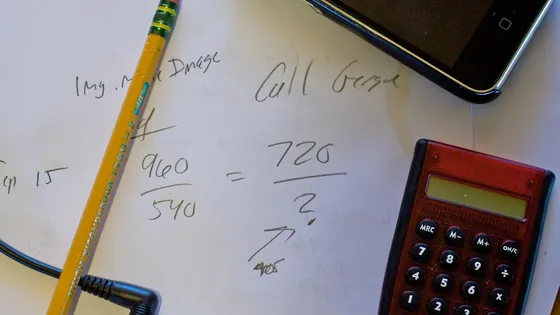
Why Bother When You Have a Calculator
Because the calculator is not the weak point. It computes exactly what it was given, and what it was given is where mistakes live. An estimate is the only cheap check on whether the input was what you meant.
It is the difference between an answer being wrong and being wrong without anyone noticing.
Round to One Significant Figure
Turn every number into a single digit and a power of ten, then work with those. 312 times 47 becomes 300 times 50, which is 15,000. The real answer is 14,664, close enough to confirm the order of magnitude and the leading digit.
Know Which Way You Pushed It
If you rounded both numbers up, your estimate is too high, and the true answer must be lower. Tracking the direction turns a vague ballpark into a bound, which is far more useful.
Division by Compatible Numbers
Adjust both numbers to something that divides cleanly rather than rounding each independently. 412 divided by 7.9 is easier as 400 divided by 8, which is 50. The real answer is 52.2.
Percentages in Your Head
Ten percent is one decimal shift. Five percent is half of that, one percent is two shifts. Assemble the rest: 35 percent is 10 plus 10 plus 10 plus 5. Most real percentage questions can be estimated faster than they can be typed.
Where It Pays Off Most
Long multi-step problems, anything involving unit conversion, and money. Those are the places where a misplaced decimal survives to the final line unnoticed, and where an estimate would have flagged it at the first step.